My second new chapbook of 2013, MY FORMER POLITICS, is just out today from H-NGM-N Books. I'm so excited about this and have been posting lines all day on Twitter and Facebook in spare moments, sometimes baby-on-lap. Here's a few:
---a feeling that is monstrous---and wonderful---
---all the intelligence required to feel---and to keep
feeling---bewildered---
---like hearing it’s on the way---when it’s already here---
---forgetting what I was saying---I always forget what---and I
always am saying---
---there’s this place I live---blindly---
---it looks easy---traveling via various equations---venting
off the vapors---that protect---the economy---
---flowers seeding---the sound of a sound---hair on the back of
a baby
---so you know to go the way---impasse---provides---
This chapbook took shape out of poems with holes in them, some of which were published in journals like The Modern Review and Sorry 4 Snake. A longer interview about my process will appear on H-NGM-N's tumblr feed.
Farrah, Roman and I are hitting the road in the south! We just survived our first flight with the baby and are now in New Orleans LA where we will be attending a wedding celebration this weekend and then embarking on a mini poetry reading tour for Farrah's WOLF AND PILOT and my new Bloof Books chapbook THIS IS WHAT IT IS LIKE TO BE LOVED BY ME. Here are all the details on dates and places we will appear with strollers, snugglies, bottles and other accoutrements:
4/16 in Hattiesburg MS at University of Southern Mississippi, 118 College Dr. #5037, 5:30pm
Recently I was asked by Steven Karl (Thanks, Steven!!) to take part in a round robin interview chain - here is my contribution ---
What is the working title of the chapbook?
This Is What It Is Like To Be Loved By Me
Where did the idea come from for the chapbook?
I started working on the
pieces that became this chapbook while I was traveling, thinking about love and
how it is like reading or like looking, like trying to describe something
objectively in exquisite detail, over time, while the describer is in motion
and in flux. I had in mind projects like Monet’s haystacks seen in many kinds
of light and On Kawara’s paintings of every day’s date for many decades each in
the format of the country he found himself in and Stephen Ratcliffe’s
every-morning practice of writing the same sized poem about the same landscape:
observation as weather. I found myself thinking in particular about describing
a loved object and how this becomes a sort of projection onto a mirror, as
Roland Barthes theorizes in his very mysterious and beautiful book A Lover’s Discourse. Nursing a
distance, looking very closely, but also looking at something imaginary at the
same time.
I found my way to the line
“This Is What It Is Like To Be Loved By Me.” With these ideas embedded in it,
the phrase seemed vertiginous, oscillating back and forth between the position
of the lover and the object of love, projection into a paradox. This
complicated effect of suggestion and identification is I think often a key part
of reading, and certainly almost always writing: hearing someone else’s voice
in one’s head, being infected by feelings. It probes narcissism but in a funny,
raw-nervy way. And maybe a creepy way too – I held on to the image of watching
someone sleep—a kind of strange and special intimate thing to know about
someone that they can’t know about themselves.
Under the
heading “This Is What It Is Like To Be Loved By Me" I started writing, adopting a
diaristic/daybook mode which meant that the poem could become a story of a
relationship over time, dilating and contracting and deepening. I mean the
open-ended relationship of poems and their speakers and their readers but also a
very particular relationship, as I incorporated little jokes between my wife
Farrah and I: our road-trip games, our joshing turns of phrase. We got married
between the time I started writing and finished editing this poem so I couldn’t
help making the poem romantically not only a courtship itself but also the
record of one. But it isn’t so much a poem about falling in love as about being
in love.
Many pieces for this series
formed while I was traveling; sections take place by the pool in the Hotel
Oceania in Santa Monica, in my parents’ cabin in Northern California where I
stayed for a few days by myself in January 2011 writing, going for walks and
reading R. Crumb’s illustrated Genesis,
and (in fantasy at least) riding the Trans-Siberian Railway which I hope to do
actually someday. Somehow Winnie the Pooh and Leo Tolstoy came into the poem.
Rimbaud’s line “Je est un autre” – I is an other – kept occurring to me. I have
been working at the same time on poems involving the Norwegian folk hero Peer
Gynt so somehow with his looky-loo first name like a burglar he jimmied his way
into this poem too.
What genre does your book fall under?
This series of
pieces started out as see-what-happens prose in which the opening phrase was
sometimes a prompt and sometimes a way of complicating or interrupting or
redirecting the flow of an impulse or an idea. As I was editing and looking for
ways to bring more air into the prose I came across a great piece by Brenda
Hillman in Lana Turner #2 adapting a hybrid form called ‘haibun’- mixing haiku
and prose. I think the idea traditionally in Japanese literature is to use to
the prose in a travel diary-memoirish way to situate the haiku pieces so these
little gems of observation and contemplation are presented in a fabric of time
instead if floating in space as they usually do. Haibun’s cut lines can aerate
the prose while prose blocks impart to the cut lines a jazzy sense of
contingency and visibility like a viscous colored liquid imbued with bubbles. I
love how the form foregrounds travel and motion and the sense of a work as its
own commentary, writing in dialogue with its process of creation, a journal of
an adventure. Thus it comprises not only viable haiku-sized poems with a prose
midrash of elaboration but a single long hybrid work in which it is possible
for more unexpected things to happen. Hillman’s contemporary adaptation of
haibun was extremely inspiring to me. (Here’s
a link to her poem, and while I’m googling I just came across another example here.
And incidentally today I happened to spot that EOAGH just published a haibun by Steve Benson, using
the haiku as part-hinge, part-springboard to leap into a void…) These American
haibun show me how the form could work against essay and normal prose poetry
writing like engine-braking with a gear shift in a car, dramatically changing
the pace by using the text’s own momentum against itself. Similarly, just by rolling forward quickly
enough and forcing the stick shift into gear, it’s possible to get a car to
start.
What actors would you choose to play the part
of your characters in a movie rendition?
Here is a
partial list of dramatis personae for This Is What It Is Like To Be Loved By Me:
A bicycle.
The City of Philadelphia. The City of New York. A salt flat in Utah. A volcano.
The Berkshires. Fog. Peer Gynt. Gertrude Stein. Arthur Rimbaud. Leo Tolstoy. The
mathematician Georg Cantor. Snow monkeys. Sea lions. Anarchists. King Arthur. Calypso.
Ulysses. Gulliver. Winnie-the-Pooh. A
bearwolf. Me. Farrah.
This film is
a fiction autobiopic so everybody can portray themselves – or versions of
themselves (think Arlo Guthrie as Arlo Guthrie in “Alice’s Restaurant,” John Malkovich
as John Malkovich in “Being John Malkovich,” Eminem in “8 Mile,” Howard Stern
in “Private Parts,” Los Angeles in Thom Andersen’s “Los Angeles Plays Itself”).
But like these movies there is a script – this is not documentary or
improvisation. It doesn’t matter whether the actors are good or convincing
actors; in some ways it works better if the self-impersonations are vague and
stylized and somehow unconvincing. The screenplay, like what it is like to be
loved in the poem, is by me.
The
chapbook includes these lines: “The
actors portraying us tell us how we look each morning. They study our trash to
fill us with hope.”
What is the one sentence synopsis of your book?
This is this is what it is
like to be loved by me.
(These words are what it is like to be loved by me.) How long did it take you to write the first
draft of the manuscript?
I started
writing pieces for this series on an October 7 – I know because that’s what it
says on the first page of the poem, in the poem. I think it was 10/7/10. I had
gone to Los Angeles for my friend’s bachelor party in Big Bear and afterwards I
stayed near the ocean, writing and getting ready for a road trip of readings
that would take Farrah and me from Venice Beach to Austin, Texas where the same
friend was getting married. One day I took a break from writing for an
afternoon and rented a Segway and rode along the Santa Monica boardwalk feeling
ridiculous. Mostly it was rainy, which was very weird since I thought it never
rains in LA. When Farrah arrived the day before our reading at Beyond Baroque
the weather cleared so we took out bicycles and rode north on the boardwalk to
the edge of Pacific Palisades and Malibu. On our way back we tried to head in
from the coast and had to ford our way through a huge puddle of rainwater in a
tunnel under the Pacific Coast Highway.
I
continued working on the prose blocks that became This Is What It Is Like To Be Loved By Me for the next year and a half, during which my cat died, I went on a
Tolstoy reading marathon, grew out my beard and then shaved it, got
married, and conceived a child with Farrah. The manuscript was finally
finished during the spring and summer of 2012. Who or what inspired you to write this book?
My wife Farrah. My friends
and their weddings. The opening line from Dante’s Inferno about the “selva
oscura” – dark forest – in which he finds himself midway through
life. What else about your book might pique the
reader’s interest?
This chapbook has sex-style
sex in it. It also includes secret instructions for getting into a house in
Sudbury, Massachusetts and the true story of how I met my wife in the Kensington Stables in Brooklyn taking horseback-riding lessons, years before we exchanged even a word. I've also included the rules for
a very fun road trip game we call “zip zip,” which involves scoring points when you spot horses. When you pass a graveyard, you shout out "bury your horses!" and the other person loses all their points. It is ruthless and morbid. When we drove across the country Farrah
and I tried adding bonus points for silos during the long trek across Iowa but
that made it too easy and I don’t recommend it.
Will your book be self-published or represented
by an agency?
Shanna
Compton of Bloof Books has been extraordinarily generous in making an amazing
edition of this chapbook as part of an incredible lineup of chaps from
phenomenal poets. As one of only a couple men published on this great press I
feel particularly honored. I’m speechless and beside myself with excitement.
I'm traveling the west coast this week with Farrah, in support of her new book from Four Way Books, WOLF AND PILOT! We are traveling with Dan Magers; here's our calendar for the whole tour -
Last week Farrah and I finally returned to a movie theater for the first time since we spent twelve hours in early July with Jacques Rivette's Out 1. We headed over to one of our favorite Brooklyn spots, the Cobble Hill Cinema and saw Woody Allen's "Midnight in Paris." I always love to go to the movies and as far as this one went I was basically satisfied and entertained though it was kind of a Cliff's Notes Expat Guide level tour of modernism. In one scene, Adrian Brody portrays a youngish Salvador Dalì who intones his own name as if it were a magician's flourish, with every word seeming to be preceded with an implied ellipsis like... this!), then lapses into shallowly 'surreal' reverie of a frolicking rhinoceros. I joked with Farrah the other day that this rhinoceros bit, built out of randomness repeated until it becomes funny, like a recipe, seemed to take on some weird extra resonance because of Brody's own enormous rhinoceros-ish beak. (His Dalì was way more about jolly nose than sad eyes, I think. Woody Allen's Man Ray was less fun, since he lacked any Emanuel Radnitzky Brooklyn-ness and was left essentially played the widow's peak and nothing else.)
During my freshman year of high school I played the pivotal role of the Grocer in a production of Ionesco's Rhinoceros. (Maybe four or five lines and mostly a lot of quiet background color during monologues by the principles sipping espressos at the cafe stage-right.) Sadly, in the middle of the first act in our debut and probably only live performance, I was stranded onstage by my supposed partner, the Grocer's Wife, who broke the fourth wall mid-scene to chat with her friends in the audience, leaving me to frantically revise our planned background business into a slapstick soliloquy. I recall pantomiming a comprehensive spit-shining of our fruit stand with each imaginary apple apron-wiped to a perfect invisible red in a futile attempt to drag her back into character. I think the trauma of this abandonment must still be raw because I don't remember if we ever actually transformed into rhinoceroses as prescribed by Ionesco, though I suppose it must be so, if perhaps only offstage, inexorable grind toward ridiculous apocalypse. Why not!
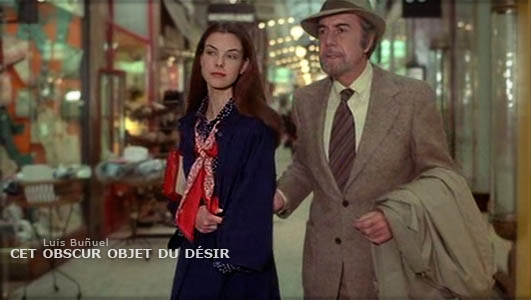
I can't remember if I wrote this on the blog before (it's been awhile! I'm going to try again to knock up some more current thoughts here!) but I have been trying lately to write poems with closures that work like in late Bunuel films when the characters are talking and then all of a sudden out of nowhere come huge explosions and... Fin! For instance, in "That Obscure Object of Desire," the Fernando Rey character walks with Conchita in one of those flaneur-ish 19th century arcade malls and peers into a store window and then... boom! Fin!
A poem I finished last week concludes with a recitation of my phone number and cell phone. Just in case! A kid I knew in high school was extremely proud about calling Allen Ginsberg on the phone, just to say hello because why not, since Ginsberg was listed in the phone book, because why not.
I've been in Massachusetts since we were mandatorily evacuated from our building in advance of Hurricane Irene. I found my sister's copy of Walter Benjamin's Arcades Project and loved the first few pages. Benjamin describes how Daguerre began his career as a panorama painter and began making proto-photo daguerreotypes the same year his panorama gallery The Diorama was consumed in a fire. (Boom! Fin!)
My conversation with Farrah about Adrien Brody's rhinoceros nose took place in a parking lot of a Walgreens in Waltham where, ten years ago on an icy winter night, I slipped off the curb and flipped over entirely upside down in mid-air before landing hard on my head on the asphalt.
Last evening I spent awhile at the Harvard Coop bookstore in Cambridge, picking up a physics textbook for my sister while she was in class and then sitting in the cafe and reading "War and the Iliad" which many friends of mine will be reading this month though I will be unable to join our discussion of it because we will be away on our honeymoon in Rome. The physics textbook, being used in a course for pre-meds, depicts on its cover a skier in mid-air, overlaid with vector lines showing velocity, acceleration, etc. We joked about a skier coming into the emergency room with a broken leg and the doctor graphing emergency parabolas, ever grateful for the premed training. Now I think of Herzog's Sculptor Steiner, plummeting off dangerous ski jumps if only prove their danger to the unheeding judges.
Several people online write with consternation that the Trojan Horse does not appear in the Iliad. No Cassandra, no Laocoon, no burning of Troy.
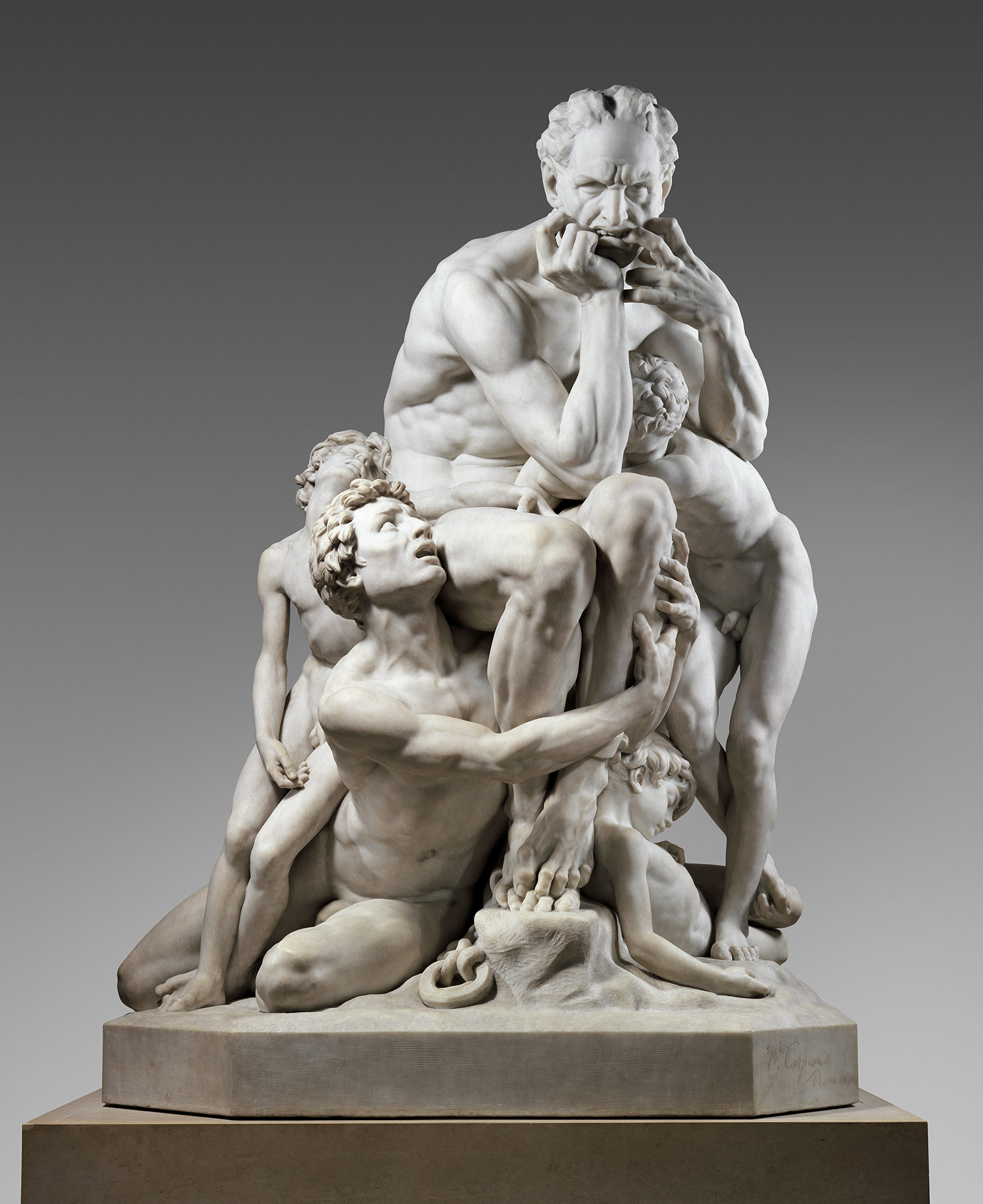
I would like to see Michelangelo's statue of Laocoon and his sons, being strangled together by a welter of sea serpents. I can't figure out how it has become so indelibly stamped in my mind despite my never taking an art history course or seeing it in person. It makes me think of a statue at the Met by Jean-Baptiste Carpeaux that depicts Ugolino, from Dante. Apparently, for Carpeaux it was a sort of homage to Michelangelo's earlier piece, which I only just now learned. Ugolino has the most amazing expression, gnashing stone teeth.
Our sweet old cat has been diagnosed with extreme tooth decay that is causing nosebleeds and making it harder for him to eat, though he seems preternaturally unfazed, brave, macho, stoic. The veterinarians need to perform an echocardiogram to determine if he can be safely anesthetized for the appropriate dental care. We brought him along with us from Brooklyn to Massachusetts as a third evacuee from the storm. This is his first visit to my childhood house in Wayland. When we arrived, the radio was reporting tornadoes spawned by the hurricane and I said to the cat, "we're not in Kansas anymore!"
For the first couple acts of an excellent production this summer of Shakespeare's "All's Well That Ends Well" at the Delacorte Theatre in Central Park, I was terribly distracted by aural déjà vu, trying to place the vocal tone of the actor playing Parolles. He was extremely funny but there was some so oddly familiar about him. Finally I closed my eyes and spent practically a full minute with my eyes shut before realizing that he was channeling Bert Lahr as the Cowardly Lion. Which is fairly perfect since Parolles is totally cowardly and totally a lion.
Farrah and I have shared a running joke for ages in which we refer to our cat as a doctor and make reference to his MD. We have conferred on him in this role as physician the last name "Chinski" and we riff on consultations, diagnoses, etc. For no particular reason we decided that his specialty in medicine is as an ear, nose and throat doctor, an ENT.
I remember as a kid being driven many times along Storrow Drive in Boston past the Massachusetts Eye and Ear Infirmary and always noticing the name, emblazoned in huge type on the side of the building. Just past the hospital was a billboard advertising the housing development at Charles River Park that read, "If you lived here, you'd be home now."
Once when I was six or seven years old my father had to go to the hospital in for emergency treatment when, running through the woods outside our house: he had scratched a cornea on a tree branch. Afterward he had to wear a Robert Creeley-ish eyepatch for several mythic-seeming weeks.
While picking up the textbook for my sister tonight at the Harvard Coop I spent a while perusing the neighboring shelves, reminiscing about this ritual from college in which I would shop classes by shopping syllabi, and luxuriating in all the readable, studyable things someone will soon be teaching to someone. At random I picked up a copy of a short Caryl Churchill play from a bookshelf devoted to some sort of course being offered in contemporary drama. The play, entitled "Far Away," was extremely engrossing; it took place in that pseudo-fascist-martial magical alternative universe dystopic present a lot of contemporary fiction seems to take place in (likeJesse Ball's "The Curfew," which I've been reading aloud to Farrah sometimes in the car when she takes a turn at the wheel).
In the Churchill play, the first scene has a girl reports to her aunt about violent, vaguely genocide-ish actions she has secretly witnessed her uncle participating in; later, the girl crafts odd, elaborate hats for a procession of prisoners to wear for some sort of mass execution that is performed wordlessly in a devastating sucker punch of a sequence slotted into the middle of the play. Churchill insists in a prefatory note that, despite only four castable speaking roles in the play, at least twenty and even a hundred other actors should be conscripted into this pageant scene, if not more.
At the end of "Far Away" the girl launches into a shocking monologue about how the entire world has been engulfed in war, with not only guilds and nations of people have taken sides, but also species of animals, plants, objects, even light and air turning into homicidal partisans and soldiers. The memorable last image of the play has the girl describing dipping a foot into a river, uncertain of whether the river can be trusted or whether it is an bloodthirsty enemy combatant.
Later in the evening, I read from "War and the Iliad" the last part of the essay by Rachel Bespaloff, discussing the ethics of the Iliad. Bespaloff relates how Homer's gods manipulate the elements of the world - dust, birds, light - to intervene in the world of the war between the Greeks and the Trojans. Yet even the gods too are ultimately humbled by the great inexorable wave of "Fatum": things turning out as they turn out, the possible giving way to a history of whatever happened. In the meantime, Bespaloff writes, "A grand anthropomorphic imagination forges a new bond between the individual and the universe, sanctifying the relationship of man to the elemental forces. Mountains and islands, rivers and springs join in the praise of God or enlist in the struggles of heroes."
My dad found a remarkable video on youtube, showing the flooding in our neighborhood the day after the hurricane.
A few years ago we visited Jesse Ball and his partner Thordis in Iceland and they took us to the edge of the tectonic rift at Pingvellir at night. We thumbed a cork into a wine bottle and sat at the edge of the ravine, watching the aurora borealis glimmer endlessly over the vast dark plain. Against the darkness the craggy protuberant boulders along the path became such anthropomorphic heaped giants it made a belief in Scandinavian trolls guarding the night seem entirely reasonable.
Before the storm Farrah and I debated whether to bring all our binders full of poems in the car with us to Boston for safekeeping. East River waves apparently lapped the sidewalk in front of our building but no damage, thankfully--even the towels we draped on our windowsill were dry.
Here in Massachusetts the Sudbury River flooded picturesquely and I kayaked around, grazing the tips of bushes submerged in water with the bottom of my boat.
I tell myself that the storm, luckily less dreadful than feared for most places nearby (though not all, sadly!), may be a symptom of ongoing global warming in which extreme once-in-a-century events are becoming almost commonplace. The past will now be unreliable as a guide to the future of the present.
Taking stock, the only serious casualty for me from the hurricane was the frustrating though necessary cancellation/postponement of my reading for the Stain of Poetry series, which should have taken place on Friday. Among a few other newish poems I had been planning on reading the one with my phone number at the end of it. It is entitled "Ancient Yoga of 1880" and is not as far as I can tell part of my growing manuscript of poems involving Peer Gynt, which I am calling THE TROLLS. I loved Robert Wilson's production of Ibsen's Peer Gynt at BAM a few years ago and have been working on this ever since.
The Brooklyn Flea, where we bring a selection of chapbooks out every weekend as Berl's Brooklyn Poetry Shop, was also canceled because of the weather. In writing this piece I realize just now that, as co-proprietor of this outdoor stand, I am replaying my role as the Grocer in Rhinoceros, sweating away beside a table of wares. Sometimes this summer, despite the shade under our tent at the Flea, at the end of a long hot day everyone looks like a rhinoceros.
I love writing "rhinoceroceros" as the title of this post. I wrote an email to my friend recently offering "congratulatations" and she said this reminded her of a Aram Saroyan poem (eyeye! lighght!) and I felt happy about this
Farrah listens to political podcasts sometimes these days as she knits and then mutters knowingly to me afterwards, "Hell in a handbasket." It makes me think of her bicycle basket, which attaches jauntily to her handlebars. It has a little sliding latch so it can be removed for errands, though sometimes it sticks a bit and has to be jiggled loose.