Tuesday, November 11, 2008

here we go again again


Speaking of movies filmed in my neighborhood (well, sort of speaking, in the sense of speaking a while ago in my last blog post, now cobwebby), tonight I went for the second time to see the movie Synecdoche, New York, which I admired all the more for being able to watch the edges of the frame, the extras who the film insists are not extras but heroes of an unimaginable performance art piece that swirls around them, centerlessness implying gleaming centers every which where. My friends and I, somewhat embarrassingly, were the only ones in the audience laughing at the movie's dark, cruel, humane jokes - everyone else seemed vaguely shell-shocked by the miserablist palette of decay and soily bodies. But I absolutely adored it.

It's a drastically swervy story, setting out to explore depression, disease and deterioration and then veering off into manic creation, existentialism as an excuse for endless recreation of the present, trying to slice greater and greater chips off the fact of the passage of time. Thus the act of reenactment becomes pretext for more reenacting, which is to say the present builds the future. The film keeps lurching forward in its timeline, starting in 2005 and then silently bypassing our actual late 2008 to graze plausibly along into furrows of the near future.

A character at one point says there is such a thing as fate, it is what is happening. So why not let it keep happening? Who should let the present get in the way of telling a story? (Screenwriting last month, my collaborator and I spent a while discussing whether to set our story in the presumably similar futures of 2009 or 2010; either way, the date will presumably be past should our script ever be filmed. But how ambitious can we reasonably be?) On the other hand, the hero of Synecdoche New York, a theater director mounting an unconventional revival of "Death of a Salesman" featuring twentysomething actors in old-person makeup -- funny-tragic, see? -- by defending his casting choice as "a decision." Because decisions are what artists do that make them artists, you know? If this is a story about loneliness begetting art as a quixotic race against impermanence, the secret problem is all about deciding: which way won't we get caught? which way won't they catch us? (who are they?) Characters undertake the most important actions for reasons they barely understand; meanwhile the actors in the movie are handed constant, obsessive notes detailing their motivation.

I was reminded of the novel "Remainder" by Tom McCarthy which I read last summer, a similar story about a person who uses an unexpected windfall of capital to recreate the past - or, more precisely, the feeling of the present as it recedes. The narrator tries to copy exactly the material of a memory which he can only recall partially and out of context. It becomes a quest to find the perfect building that can be retrofitted to resemble the memory, the actors who will resurrect the event. Yet McCarthy veers a different way, not into the painful self-consciousness of recreation but the aggression underlying this desire to control, to be creative. The narrator of Remainder turns quickly from Proustian apartments to more exciting recreations of chaos and overstimulation. He orders reenactments of gangster murders reported in the newspaper, then a crime that has never even occurred. The endless possibility for decision making becomes an excuse for a childlike id to run amok, to make present.

By contrast, Synecdoche, NY seems far more concerned (qua the title) with the metonymic juxtaposition of elements (children and their future adult selves, for instance, placed side by side in montage) than with any metaphorical work of transforming or distorting reality to be something else. The violence is all inward, and yet beyond the stage, the film suggests that the world at large is falling apart. The truth is only that how it feels right now is a feeling that is followed by another feeling that occurs at the next moment - the film turns repeated to the clock and intones "Now it is 7:43, now it is 7:44."

I wrote a poem recently called "Post Meridiem" that dealt precisely with this problem, trying to think rigorously about the nature of time intervals through the clarification of a bounded absence of, notationally, thirteen minutes. I was thinking about the waiting that takes place while events occur, impermanences but not impermanences that are galling, rather those that reassure. Don't worry, it will come back, it will leave again and come back again. It is not only loss you will face but the loss of loss and then, even so, bearing with it a new unbearable business dealing with desire, with love, with history. A short time can be no different than a long time. Time simply passing is epic, is the epic.

I hadn't made the connection at the time when I was writing this, but "Synecdoche" and the movement of waking up, 7:43 becoming 7:44, prompted me to recall my visit several years ago to Walter De Maria's Lightning Field in New Mexico. The epic art piece distributes over a huge plain in perfect geometric rows a series of pencil-shaped vertical lightning rods, jabbing out of the dry desert earth. The effect, though, is not only to discipline space, but time - walking through the array, step by step, the spires pull into alignment, forming an asterisk of intersecting corridors. Another step, then it is a phalanx of poles once more, a flowchart of obstacles. One more step, one more eclipse, one more decentering.


The secret advice given to pilgrims who visit the Lightning Field is to wake up before dawn and wander the array in the waning darkness. Despite the artwork's ominous title there is little risk of being caught the lightning that buffets the plain almost daily; the weather stabilizes at night. One must be outside, in any case, at the precise moment when the sun breaches the horizon. It is just then, for no more than a minute (now it is 7:43, now it is 7:44?) that the tapered tips of De Maria's poles catch the sunlight at the perfect angle and glow brightly, briefly. Then, the effect dissolves, the day finds its own equilibrium, for a while. This is art located not where it is alone but also when it is. It will happen again, just exactly so, after another day, twenty-four hours exactly. Give or take a minute or two.

Monday, November 19, 2007

from no distance at all

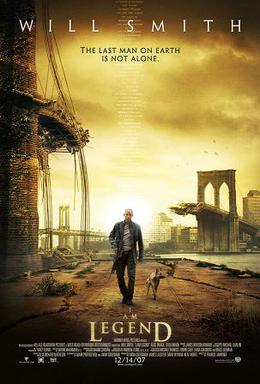
Today while stopping at a crosswalk uptown waiting for the light to change, I spent a while soaking up the poster for the new Will Smith movie I Am Legend, printed on the side of a city bus. Hilariously, the picture features Will Smith standing somewhere under the FDR downtown in Manhattan looking across a post-apocalyptic East River of broken bridges towards DUMBO with my apartment building framed gloriously in the near distance. It's wonderful in a way, seeing my building so stately and picturesque and sepia-toned, surviving armageddon--and seeing it approach me so randomly in my commute around the city. I remember once while I was on a vacation in Canada, driving as faraway as I could possibly drive from New York, turning on the television in the city of Prince Rupert (just south of the Alaska border in British Columbia) and watching a ridiculous cop movie starring Jim Belushi as a dirty cop making drug deals around the corner from my house. Perhaps it comes with the territory of living in a New York that has fully transitioned to internationally beloved simulacrum (with all the attendant traffic problems) but the Will Smith poster sent my thoughts in an alternative direction, thinking about futures of the past and pasts of the future.


In the poster (the movie's filming kept Farrah and me up nights during shooting with klieg lights under the Brooklyn Bridge blowing out refugee-flee-manhattan-extravaganza shots and inadvertantly scorching my bedroom with film noir shadows), a huge photoshopped sun frying Will Smith in a halo of light neatly blots out the new, inappropriate skyscrapers that have cropped up in DUMBO over the last few years--as I understand it the result of bait-and-switch tactics from developers taking advantage of architecture-buff neighborhood boards in 2002 but then stinting on the architecture. Perhaps this is merely the result of the I Am Legend being photographed some months in the past, before the buildings were completed. Or perhaps they did not fit the vision of the art director looking for the post-apocalyptic mood to befit a disaster-horror movie. But what occurs then appears to be a vision of a future New York that either demands a selective tearing down of recent changes (a conservative future as return to the past) or an understanding that the future is already defunct, that we're already there, and past. In a way, I prefer the second possibility, which certainly feels accurate to the wonder of watching old movies with young people captured and now no longer young. (In many ways all my poetry writing these days feels leveraged on this disjuncture, the writing moment receding into funnier and funnier miscues, distortions, changes.) It all reminds me of the historical epics of the sixties, say, in which everyone seems to have sixties hair. I wonder, did they know that they were creating a vision of Ancient Rome, or medieval England, or Renaissance Italy so utterly dated? And what will happen when shaggy sixties hair comes back into style unironically and without distance; will we watch these movies and think how utterly accurate they seem as pure history?

The Will Smith movies calls itself I am Legend and is its own bait-and-switch if it's anything like the pretty good novel, a post-apocalyptic disaster story that turns out to be a by-the-book vampire-vs-van helsing throwback, very doomed machismo. The legend is presumably Dracula, Transylvania, et al and the crux of the book is that if its protagonist is living in legend (vant to suck your blood etc.) and is A legend (a lone hero standing against the monsters) there's no one left to remember him. Will Smith (like Charlton "The Omega Man" Heston before him) is made of Legends lacking people to possess them. But isn't this the problem of the sci fi film which is always a historical drama, the future as it could have turned out but didn't, the story that didn't procreate, no one remembers what didn't happen, dogs not barking, etc.? Trees falling on each other in the woods. Or suspension bridges with the snapping cables magically missing my vulnerable windows... My sister has been studying for the GRE and, relating the fortune cookie essay question topics to me, she mentioned one that asserts that we can't learn from history because we're living in it. A lot of the questions have this weird parallax of essaying pessimism from a vantage point of freed up energy, such as decrying competition while competing for trails of a grad school bell curve or eschewing study in order to embark on the most intensive study of one's life. Here is the past of me, now how about some future?.What happens next.

Sunday, October 21, 2007

cardboard paper tigers

In one of the most lovely scenes in Jean-Luc Godard's La Chinoise, which I gratefully caught a rare screening of tonight at the Film Forum, Jean-Pierre Leaud and Anne Wiazemsky (I think it was her but my memory could be failing me; it could have been Juliet Berto in this scene) share a cup of tea. He comments, apropos nothing in particular, that he wishes they were blind so that they would pay more attention to words, listening and speaking. Somehow the fleeting idea sets off a chain of free word associations back and forth, Leaud and Wiazemsky throwing Maoist buzzwords and catchphrases at each other punctuated by Leaud's "tenderness" and--responding to her paper tiger--"rock..." (a dramatic sip of tea) "..and roll." The moment encapsulates Godard's wonderfully double-edged portrayal of his earnest student heroes: responding with great tenderness to their seriousness of purpose and youthful idealism and at the same time ironically aestheticizing their ideals, placing them in front of overwhelming color fields and confronting them with the deflating faces of older radical politics. It is a movie as much about age and time as it is about social change or group identity. Like so many of the French nouvelle vague movies of the time (like Jacques Rivette's Out 1 or, a latter day reenectment, Philippe Garrel's Les amants reguliers) is partly wonderful is the setting, always the most concerted regency chairs and ornamental wall moldings to appoint the revolution.

Filling the wall panels with chalkboards and painting old window shutters Chinese red, Godard gets this; his main argument is more with time than with culture as the serious worst imperialist. Or he would refuse to make the distinction. (Another key moment has Wiazemsky turning up the radio and staging a romantic breakup with Leaud to teach him the power of keeping multiple ideas in the air at the same time. Multiple fronts.) And yet the tenderness seeps through the ideas, the way in the middle of lexical association Leaud can't help himself from a little of the word. The tension of loving the culture one is sworn (somehow, anyhow) to abolish.

I am reminded of a time when, on a drive through quiet Massachusetts woods last summer, inspired by various online questionaires, Farrah and I played a word association game of our own, throwing random words at each other to see what would pop out of the other's mouth. One of us was supposed to be leading with the word prompts, the other with the telling stream of consciousness. In practice, though, we both thought the other was in the directing role and we were merely following. Then, for maybe twenty captive minutes, we went back and forth with words: response, response, response, swimming further and further along through the language. I learned an actor's exercise in summer camp in which, like Groucho and Harpo and Chico in Duck Soup, two people would mirror each other's gestures across an imaginary midpoint, slowly trading the phenomena of decision until like a ouija no one could tell who was in charge. Is that the real anarchy: no one in charge? Or is it, don't worry: someone is the director, maybe all of us this very minute?--but sorry, no one's saying.

Friday, October 19, 2007

dream songs

My central enthusiasm of the last few weeks has been Neil Gaiman's exceedingly rich series of graphic novels collectively called "The Sandman." It is a gift of a narrative, variously textured, with stories of horror, magic, wonder and myth as well as more practical concerns: love, mourning, gender, politics, religion. I haven't read much Gaiman before - only the nifty horror tale "Coraline" - but what is so striking here is his serious humanism, a willingness to accept various characters in their inadequacy and difficulty and by returning to them over and over again over the course of many years of work on the project, find a openhearted forgiveness for each. It is not moralistic in opting out of unhappy endings, but it is a moral universe he creates, in which there is serious goodness.

One of my favorite parts of the work is a scenario in the third volume which the hero, a punkish brooder who is the embodiment of dreaming, has commissioned Shakespeare to write A Midsummer Night's Dream as a tribute to the actual King Auberon and Queen Titania of fairyland. The play is then presented to an audience of fairies (Puck, in particular, objects to his defanged portrayal as a benign joker), presented in a pastoral stage en plein airas if it were the original summer Shakespeare-in-the-park performance. This radical notion re-envisions this fanciful comedy as something closer to one of Shakespeare's history plays, with all the associated baggage of politics and the patron who must be minded--as in the way Macbeth, for instance, implicitly lionizes the new King James. A Midsummer Night's Dream already has a certain self-reflecting quality; Gaiman doubles down the mirrorings and discovers new wellsprings of poignancy, beauty and depth in the play. Making it new, making it fresh.

I kept having to remind myself as I read The Sandman that it was a 'guilty pleasure,' mainly because it is easy to read, riding on the greased slope of visual storytelling and cultural association. I met with the poet Marjorie Welish this week to discuss my poetry manuscript in progress (depending on when you ask me it is coalescing, near finished, long completed, and/or scarcely begun) and her advice to me, regarding my own poetic output, was that if something comes easily, you're not making it hard enough.

In a way, I think this is the central problem for comic book experiences like the one I had with the Sandman--it is profound, challenging emotionally, complex narratively--and yet it necessarily flies by as all comic books do. Even as it engaged the question of pastiche and the introduction of soap opera superhero narrative elements, the Sandman seemed to use such a light hand and such a free associative delicacy that it is hard to see these as inorganic or shallow. And yet I'm chastened by Joshua Clover's peremptory criticism of Gaiman on his blog for what he sees as shallow, mealy spiritual mumbo jumbo Joseph Campbell mythwork, all pseudointellectual hero king quests. And there is something to that, though the meandering, mosaic approach of comic book narrative does much to disguise it as something more substantive. Clover dismisses Gaiman essentially as Napoleon among the dwarves and, when my girlfriend asks me why I'm reading so many graphic novels lately, I can't help but feel the sting.

Still, if I compare it with the equally redoubtable Y the Last Man, a very clever saga by Lost writer Brian K. Vaughn imagining the realistic aftermath from a worldwide plague of male hominids, the superiority (the pygmy giant indeed) of Sandman is obvious. Where most popular fictions derive their pleasure from the modulated spinning of the wheels of plot, Gaiman's dream stories excite through their nesting, their meandering, in a word their form. Gaiman is delivering form over content, which, for a story about dream and the wispy fabric of our lives, is just about perfect.

Monday, September 24, 2007

taking attendance

This appears to be my twentieth post since No No Yes Etc. was inaugurated nearly three months ago. I'm ambivalent about whether this is a sufficient pace of publication. On one hand, this has to be a secondary mode of output, creatively speaking, to my main writing, which I am getting my mind around as a book manuscript right now. But as a blog reader I know how important new blog material is, and how the old material has a way of going instantly out of date regardless of how topical or evergreen the subject may be. Even the format of the vertical blog text, which sends old entries into the internet netherzone of the archive, suggests the demand for fresh thought. I had a discussion with my mother's friend who is a librarian and who noted the problematic meshing of library science with the onslaught of online blog material overwhelming research tools and filters. In a way, it would appear, blog entries' format, with auto-archiving and permanent online niches, render the librarian almost nugatory or at least superfluous, except insofar as they might point you to the unlisted blog or the secret entry. But isn't that what Google is for? I feel like we're rearguing atonal music all over again, the science of science. But, then, who's arguing?

My own impulse in terms of inventing a blog writing style has been to think fast and try to make connections, paragraph to paragraph of the seemingly disconnected. Paul Rosenberg, a very smart blogger at Openleft.com, engaged in an interesting discussion of conspiracy theories, vis a vis Naomi Klein's new book, The Shock Doctrine, which Farrah has been talking about a lot this week. He debated whether it is conspiracy thinking to point out dormant structural connections or whether it requires a special cabal, public masks, cigars in a room where a lot of inexplicable down town occurs. Today I read Klein's related article in Harper's, which predictably raised my blood pressure but is basically a simple observation: the government has funded a disaster relief industry that now lobbies to maintain market dominance. No conspiracy, just politics.


I thought again about the fantastic Don Siegel movie I watched the other night, The Big Steal, in which one bad guy chases Robert Mitchum who chases Jane Greer who's chasing another bad guy. The movie starts out with lots of normal tough guy wit but halfway through suddenly goes wordless as Mitchum and Greer flirt by driving crazily over a series of switchbacks in the mountains of Oaxaca. Suddenly it's like a dream I keep having, taking these hairpin turns in a car that drifts through the curves as if its plummet over the precipice would be deliberate and gentle. It's not the speed that makes the characters fall in love, it's the skill with which they don't quite lose everything. Two details seem especially dreamlike: the pavement, which because of the minimal Mexican infrastructure (cf Klein) peters out almost indecisively at the edge of the road, like a passing fancy; and the background, which lurches from soundstage backdrop to reality with an antic abandon. While the projected backdrop skitters up and down, Mitchum and Greer barely jostle. They're just that good, or it doesn't matter one way or the other as long as they show up at all.

Tuesday, September 11, 2007

theology at lunch

My hair still damp, I just walked in the door from an outdoor lunchtime reading in Bryant Park that proved to have the second most exciting weather of any poetry readings I've attended. The most exciting was a year ago, when I flew to Buffalo to attend a conference at U Buffalo on Robert Creeley and landed in the midst of a gathering early October blizzard. By the time I made it downtown where the reading was getting underway in a church on the main boulevard, it was flurrying heavily, and just as Robin Blaser got up to read, an overwhelming fusillade of thunder boomed through the gallery. I remember Blaser raising his arms in mock triumph before continuing. It was obviously uninterpretable (no more than the paranoid who holds the airplane or the world aloft through their compunction) and yet totally appreciated, simultaneously overstating and understating the Importance of Art in the face of Nature as an answer that could be tiny and also sufficient. Blaser, not large, was perhaps taking credit where credit was due.

And yet the weather did win after all; I never made it to the conference. Instead, braving the highways of Buffalo in snow so thick with lake effect as to make the road signs literally unreadable, where I holed up during a total electricity blackout in a Marriott in full-on emergency mode: the electric locks on the rooms requiring manual keys and the stocks of snack-size potato chips and irradiated apples running low as the generator's gas supply dwindled. For twenty-four hours it was the apocalypse and then the plows arrived with fresh supplies of early autumn.

This time the squall arose through midtown as Joshua Clover stood behind a microphone in Bryant Park's so-called Reading Room. It had already been drizzling around the tent but the rain grew in intensity as Clover read (he suggested at the outset that the scenery was appropriately apocalyptic, and given the oddity of his reading his elegy-for-modernity-through-pop-wizardry poems on September 11 -- compounded with a setting next door to the Fashion Week tent -- one was inclined to believe him) until, interrupting the second work of a line, a huge crash resounded overhead. I wondered across the park what the runway models in their air-conditioned pavillion took as their proximate cause, which seemed surely the appropriate thought to be having: not, what should we do, but, what was it we did.

The fact that the next time Clover repeated the same word - "Capital" - the same thunder replied in its gospel call-and-response only compounded the humor, the avowedly secular death's door conversion. It was money's fault, wasn't it. (Or not fault--laugher.)

And the thing about opulence is someone will always enjoy it. (The recent Paul Goldberger article in the New Yorker lauding the new Stern palace on CPW reads like an advertisement--pay no attention to the man behind the curtain, etc.) Clover reminded me of this through the title of one of his terrific poems, which referred to the first mall in the world ever constructed, in Brussels: the Galleries St-Hubert. As if by some force, Farrah and I were drawn through the central streets of Brussels to the glassed promenade when we visited Belgium last year. I would glibly call it an American thing, and yet only in imitation.


We had a free evening and returned in the mall to a movie theater sliced off the Rue de la Reine to see the excellent, conveniently wordless German documentary Our Daily Bread. Annals of late capitalism, the film presents completely compelling images of the efficient, heavily mechanized food production system that can vacuum every nut from a well-shaken tree, carefully cover acres of root vegetable furrows in gleaming mylar blankets, and, with only a resolute, industrial thud, truss pigs calmly onto an elegant stainless steel Catherine wheel and unzip them at the belly. It's an unsparing film to watch, but excellent and inspiring, offering stories from the slow motion apocalypse that has been going on, to judge by the two-century mall on Brussels' Grand-Place, basically forever. Cue the sound effects, turn down the iPods.

Saturday, September 8, 2007

time flies buzzing

I ran out of time on yesterday' afternoon's entry and had to run out the door to go to a reading for the new issue of Lit magazine (which includes two pieces by my friend Matthew Pennock). Running down the clock meant I didn't have time to say anything about the good book I was reading yesterday, Sandy Florian's Telescope. It's a daunting bit of work--long prose pieces unpacking an abecadarian of exotic everyday objects over many pages. I had a curious experience reading it of a rapid succession of shutter-speed associations as I read: first it made me think of Gertrude Stein in its chunky syntax that is developed into something like a moral philosophy. I remember having this thought originally when I was studying the masonry of dry stone wall building in France and struggling desperately to remember and wield French vocabulary at the same time. So Florian makes me think of this, first language as a second language, workmanlike, something to strive for.

Telescope is also like Stein's Tender Buttons in its "stony stones" Russian formalistish attempt to look at an object--say, an accordian for Florian like a carafe for Stein--minus its pragmatic usage but still drenched in its visual and tactile impact and its cultural context. Suddenly I'm thinking this is a totally structuralist idea but in both cases it's too personal to become a myth.

I'm also reminded in a similar way of Lawrence Weiner's '70s artwork in which he presents not a minimalist sculpture but a description of one painted on the wall as if the word could be what it means rather that meaning it. Here's an example which I hope I get right, squinting at a too small picture on the Dia:Beacon web site: "Two slabs lying against each other to form a form with another slab lying on the ground." It's like this in Telescope, the feeling that words just have to be vacuumed and swept enough to produce something actual. It's an idea so idealistic it makes me want to try it myself, like Pygmalion.

But then at the same time in Florian's consistent use of "And." "For." "Or." etc. to link sentences I find myself pondering Bertrand Russell's Principia Mathematica and logic, all those "intersection of" and union of" ideas built out of upside-down U's and transformative ='s. Reading it is a little like unraveling a proof, following sentences into algebraic chains. And strangely this is practically the opposite of words becoming things: it's words as numbers to juggle in a perfect flowchart, the pure purest ideas. I think this is the crux of the book and what it makes it impressive, that it can simultaneously feint (float like a butterfly, sting like a bee?) to both sides of some Platonic dichotomy. The distinctions won't hold but if old metaphysics needs work here's evidence to get us somewhere.

I found Florian's name perusing the schedule of a wonderful-sounding English language reading series in Paris. Now there's an idea that's transporting.

Friday, September 7, 2007

not it

(place your finger beside your nose while contemplating)

I woke up this morning with a strange anxiety that it was possible in my last post that I had misidentified the Dorothea Lasky from the interview video as the poet--no particular reason from the video, perhaps some residue from a dream of people wearing masks of their own faces or some such. In any case, some youtube sleuthing (the video comes from "weirddeermedia" which has a link from Dorothea Lasky's site) reassures me but I was momentarily fascinated by this problem. I have thus far been fairly generous with links but it is certainly possible I would it get it wrong. I was discussing this problem with friends last night in reference to my own name which, when googled, reveals a plethora of creative and productive people who are not me. There is even a musician or two and, apparently, a writer.

These are not my accomplishments or opinions and it strikes me as strange that just as the Internet has the problem of flattening text of affect (a recent article I read claimed that this is why exclamation points are more acceptable in text messages) but also personality and identity. Taken to the extreme are horrible cases of overzealous renderings from Macedonia or JFK to black sites for questioning we hear barely about. Of course I don't mean to imply there would be some actual person for whom extraordinary rendering might be appropriate--I try to ascribe to 'ordinary' theories of people relating.

In any case, to ward off confusion, this is me now. And besides those to the right here are a few other prior instances.

Thursday, September 6, 2007

dropping a frog into boiling water

Being back in New York has me grappling once again with the notion of the structure of the city, as enveloping a situation as an ideology. Obviously there are layers within layers of decision makers and when the subway is delayed it is because someone somewhere made it so. And yet the experience of obstructed and facilitated motion is so discombublatingly organic compared to a jog in the woods, where the pace and the mind are in sync on the surface as the muscles and the neurons fire off in teams. Here it's all momentum, commuting in traffic with the laws of thermodynamics. I saw on television an interview this summer with a journalist imagining the world quietly disintegrating and also persisting after the disappearance of humanity, leaving behind a detrits of bronze sculptures and feral housepets; today I read the John Seabrook article in the New Yorker about the Global Seedbank on Spitsbergen in the Svalbard archipelago (where there is excellent terrain for cross-country skiing, incidentally) where they could collect noble heirloom plant seeds that could survive the apocalypse as a great big vegetable blight. (Spill some wine for that future passover.) So which is it anyway: screeching to a halt or skidding forever forward on the old tracks? How is it being involved, but not entirely accustomed?


I've been trying to give Farrah (yay!) good advice as she works on her novel in progress and find myself through lack of practice with fiction no longer acclimated to the basics, such as narration. It's amazing in a way that after a few hundred years of writing these things we just accept the feeling of this person writing with an "I" in which there is simply no context. I feel the same way when I turn on network television after a long time away, or right now as I wander by the propagandistic ad posters glued all over Manhattan: what a completely radical, noisy, totally artificial landscape to feel normal around. Astonishing what you don't even notice yourself getting used to. So I open a book and keep thinking, why are you telling me this. (Italics can be distributed as preferred.) Of course it's taken weblogs about ten minutes to normalize the converse relation of private/public journal. But obviously the mixture of voice and tense in fiction makes the problem all the more glaring--who are you and when did we get intimate, like waking into a marriage of amnesiacs, or at least one drunken one night stand...

I was reminded of this issue today browsing books in the Barnes and Nobles on Lexington at 86th st. (which boasts a surprisingly decent poetry section and should not be confused with the branch on 86th st east of Lexington, which doesn't) and getting sucked into Dorothea Lasky's Awe. It caught my eye because I had just been looking at H-NGM-N's web site yesterday and read about the flipbook-chapbook they made out of poems of hers and my Columbia mate Sam Amadon's. In any case, Awe was a fun discovery for the day and absolutely demonstrates the very unexplored weirdness of talk as a formal device. Lasky sometimes uses tiny emphatic Q and A intrusions into a smear of directed thoughts that suggest arrows shot off at funny angles and bouncing round to smack the archer. Let me answer my own questions, in other words, and with exclamation points. It might be a little slapstick but, you know, "poetic slapstick," as Pauline Kael said, and thus disarming and windowlike. I don't see tricks here so much as personality--there's a fair amount of the word God in the book (goes with Awe, perhaps) deployed I think as a placeholder for why anyone would tell anyone anything. Because, maybe, they already know? Funny, given my instant thought of Q and A in the bookstore that when I googled her name just now I came up with the above video of her literally being interviewed.

The other book I've been reading lately is Joanne Kyger's selected poems As Ever. I loved her poem "Carl Jung Greeted" in Stephanie Young's aforementioned Bay Poetics, which seriously ranges--psychology, politics, the cosmos--to capture a very accurate portrait it seemed to me of how it feels to feel these days. I found it fascinatingly hard to locate a copy of the book, despite its being published by Penguin--no copies for instance anywhere in Boston, so far as I could tell. Strange because it illustrates elegantly what can grow over decades in an Olsonian open field and it seems to me people that people would like that. I like this: "There was a long time in silence. For myself I can tell you that certain things give me limited pleasure for short stretches of time / but I do not know where to put them."

She can tell me, and I can tell you.